India’s Commonwealth Games champions lauded for inspiring new generation

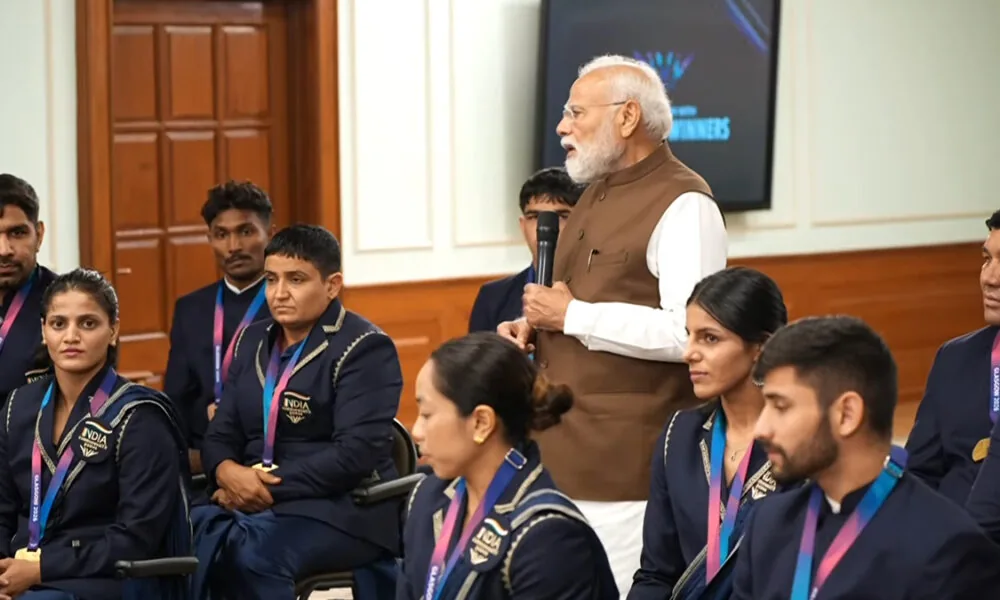
Prime Minister Narendra Modi recently interacted with India‘s Commonwealth Games champions, congratulating them on their medal-winning performances. He highlighted that their achievements are inspiring a new generation to participate in sports. Modi emphasised that these victories are not merely individual successes but serve as significant milestones that can motivate future generations across the country.
Modi noted that athletes have been a consistent focus for him over the past decade. He believes their ongoing success is more effective in inspiring children than general campaigns encouraging sports participation. The Prime Minister also stressed the importance of building a robust sports culture within the nation, stating that winning medals requires more than just improving sporting infrastructure.
Transforming India’s Sporting Landscape
The interaction underscored the positive impact of the government’s Khelo India programme. Athletes shared personal accounts of how this initiative, coupled with support from the Sports Authority of India, has facilitated their career progression. One athlete recounted winning a silver medal at the inaugural Khelo India programme in 2018, which served as a stepping stone to higher levels of competition. Modi encouraged athletes who have benefited from Khelo India to now contribute to the programme by motivating younger students to engage in sports, stating that the prestige of Khelo India is built through active participation.
Many athletes shared personal stories detailing their journeys, including challenges such as injuries, family difficulties, and narrow misses at previous international competitions. One athlete recalled missing a medal at the Paris Olympics by a margin of 1 kg before achieving success at the Commonwealth Games. The athlete described an emotional response during the medal ceremony, triggered by the sight of the national flag and the sound of the anthem, following years of hardship. Modi praised this moment, noting that every tear reflected the profound significance of the achievement.
Another athlete spoke about dedicating a victory over Pakistan to the Indian Army and the heroes of the Kargil conflict, as the bout occurred on Kargil Vijay Diwas. Athletes also shared lighter moments from their international experiences, leading to humorous exchanges with the Prime Minister during the conversation. Modi concluded by reiterating the sporting message associated with Khelo India: “Jo Khelega, Wo Khilega,” which translates to whoever plays, will flourish.
A Decade of Sporting Development
The current sporting success represents a significant shift from India’s earlier performance in international events. In 1934, at the second edition of the British Empire Games, now known as the Commonwealth Games, India secured only one bronze medal, won by wrestler Rashid Anwar. Fast forward to the Commonwealth Games, Glasgow, 2026, where a contingent of 122 athletes competed across ten sports, bringing home 39 medals, including 13 gold, 17 silver, and nine bronze. Notably, eight of the thirteen gold medals were won by women athletes.
The first Commonwealth gold for India was won in 1958 in Cardiff by Milkha Singh in the 440 yards event. The same Games marked the first participation of Indian women, Stephanie D’Souza and Elizabeth Davenport, a quiet but significant milestone. For decades, Indian sport faced challenges such as a lack of facilities, limited foreign exposure, and insufficient funding. The story of weightlifter Saikhom Mirabai Chanu illustrates this transformation. Growing up in a village in Manipur, Mirabai often struggled with bus fare during her training in Imphal.
However, in April 2021, three months before the Tokyo Olympics, Mirabai required specialist strength-and-conditioning training in the United States. Despite the global travel restrictions due to the Delta wave, her coach reported that the sanction for the entire trip, including treatment, a sparring partner, boarding, lodging, and travel, was approved within a single day. This funding allowed her to train and subsequently win an Olympic silver medal, which was India’s first medal at those Games.
This support for athletes like Mirabai is attributed to programmes initiated over the last decade. In 2014, the Target Olympic Podium Scheme (TOPS) was launched, designed to identify top sports talent and eliminate financial barriers. TOPS provides funding for the athlete’s entire support structure, including foreign coaches, physiotherapists, sparring partners, video analysts, airfare, and medical insurance. This scheme supported javelin thrower Kishore Jena for 78 days of training in Australia before Paris 2024, and also backed PV Sindhu’s training in Germany and Neeraj Chopra’s athletics setup. The Khelo India programme, launched in 2018, focuses on scouting talent at school and college levels through the annual Khelo India Youth Games and University Games, channeling promising athletes into structured support systems.
In early 2025, following the National Games in Uttarakhand, the Prime Minister specifically acknowledged young athletes identified through Khelo India, including sprinters, jumpers, and a teenage swimmer, as evidence of the programme’s effectiveness. India has also declared its intention to bid for the 2036 Olympic Games and is set to host the Commonwealth Games again in 2030. The Prime Minister’s consistent emphasis on fitness through initiatives like Fit India and his radio programme Mann Ki Baat has also made a significant impact on aspiring young athletes. In August 2021, the Tokyo Olympics contingent, which achieved India’s best-ever haul of seven medals, met the Prime Minister at his residence, presenting him with their sporting equipment, including Neeraj Chopra’s javelin and PV Sindhu’s badminton racquet.
Source: dailypioneer.com

